|
|




















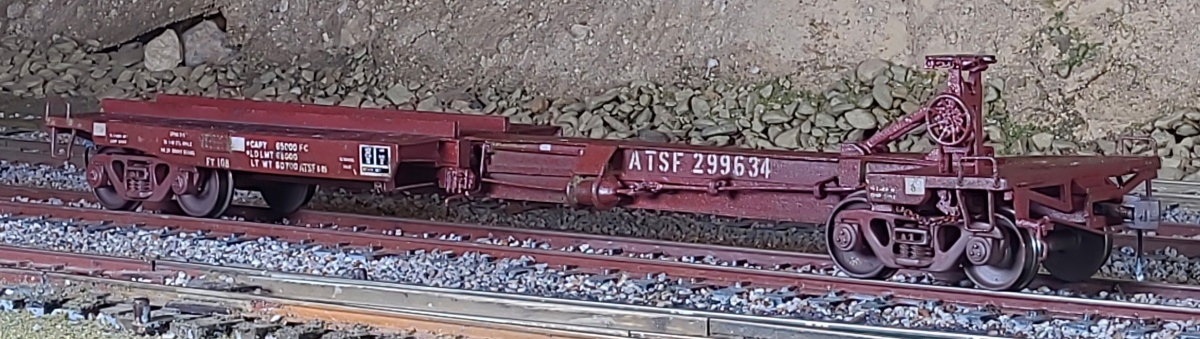

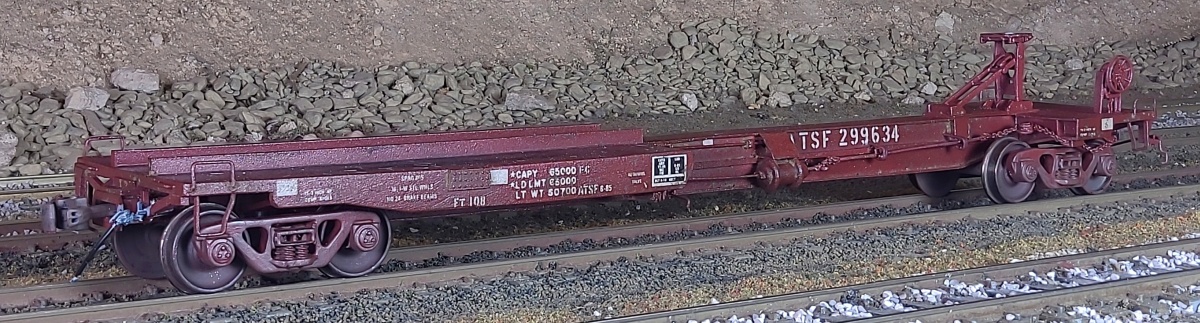
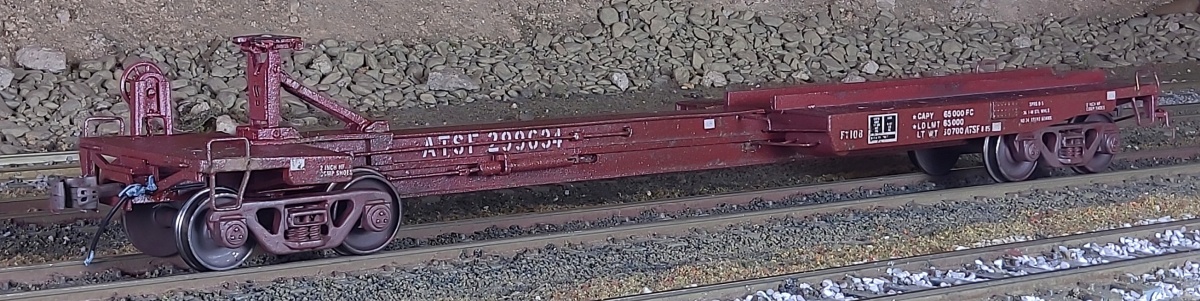

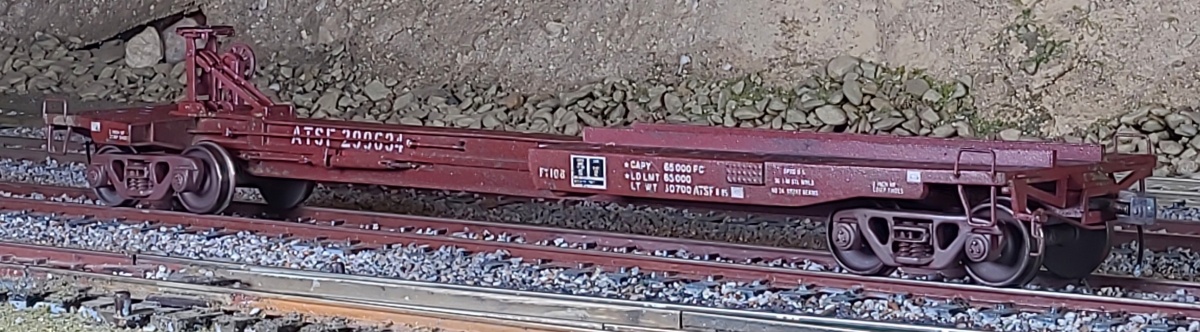
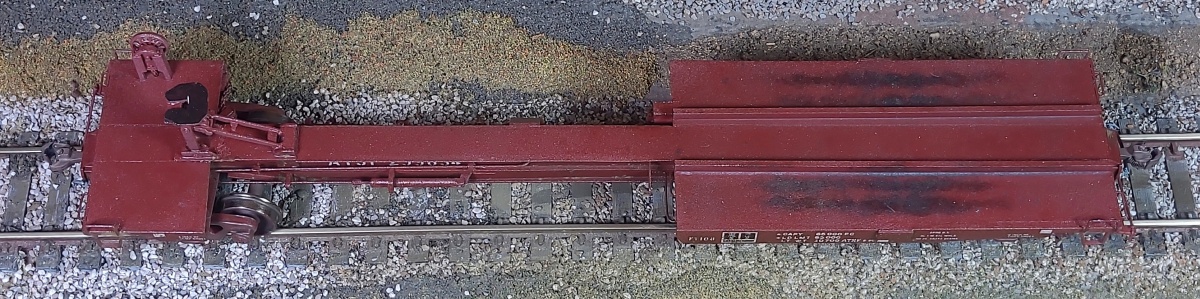
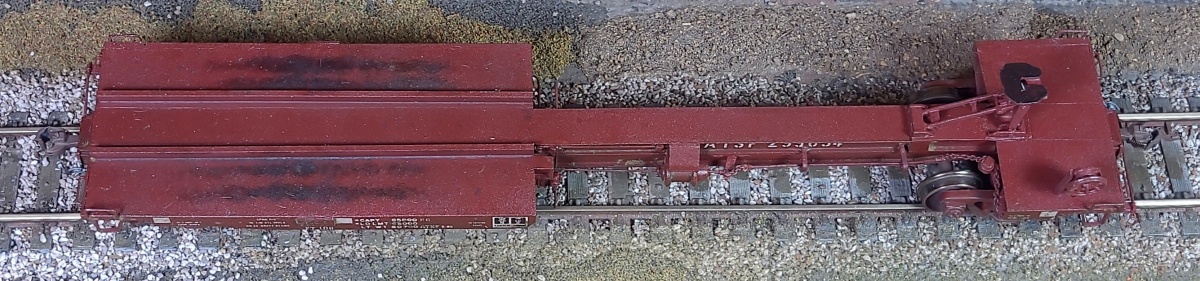







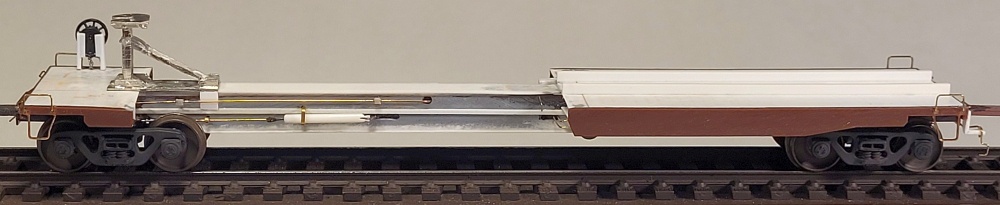
ATSF Ft-108 299634 TOFC Conversion
When the intermodal boom exploded in the early 1980's, Santa Fe needed
lots more trailer-on-flat-car (TOFC) platforms to handle all the new traffic. The
railroad shop forces met the challenge by converting hundreds of older freight
cars into light-weight flat cars specialized for trailer loading. The Ft-108 class
was rebuilt from Fe-30 furniture boxcars stareting in 1984. Most, if not all,
were painted brown with white markings. All were retired by mid-1991.
I made my Ft-108 model from a Front Range kit, heavily modified, with
added brake rigging and other details including grabs, stirrups, rub rails,
and a trailer hitch. Decals came from an assortment of Microscale sets.
When the intermodal boom exploded in the early 1980's, Santa Fe needed
lots more trailer-on-flat-car (TOFC) platforms to handle all the new traffic. The
railroad shop forces met the challenge by converting hundreds of older freight
cars into light-weight flat cars specialized for trailer loading. The Ft-108 class
was rebuilt from Fe-30 furniture boxcars stareting in 1984. Most, if not all,
were painted brown with white markings. All were retired by mid-1991.
I made my Ft-108 model from a Front Range kit, heavily modified, with
added brake rigging and other details including grabs, stirrups, rub rails,
and a trailer hitch. Decals came from an assortment of Microscale sets.
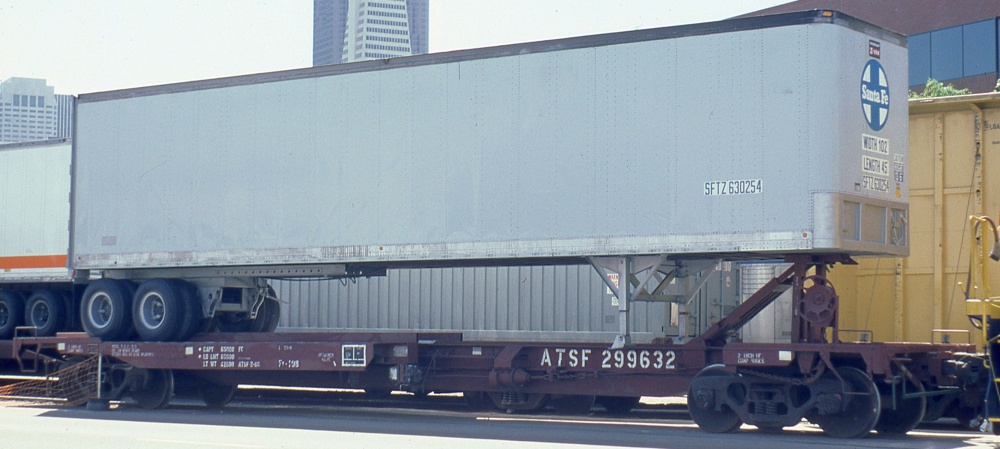
Below: I photographed recently rebuilt Ft-108 299632 at a railroad display event in San Francisco CA, with a 45' Fruehauf trailer.
This angled left-side view allowed me to see some of the structural and brake detail at the end of the trailer platform.
This angled left-side view allowed me to see some of the structural and brake detail at the end of the trailer platform.
-- About
-- Contact
-- Diesels
-- Links
entire website copyright Gregg Fuhriman
created with CoffeeCup Visual Site Designer
created with CoffeeCup Visual Site Designer
-- Layouts
-- Modules
-- Signalling
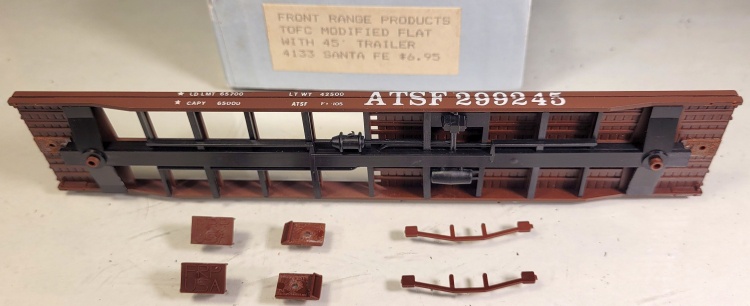
Right: I started with a Front Range
"TOFC modified flat car" kit.
These can still be found for sale
on eBay, etc.
The kit has an open deck area
toward the B end. It also includes
angled braces for the car ends.
"TOFC modified flat car" kit.
These can still be found for sale
on eBay, etc.
The kit has an open deck area
toward the B end. It also includes
angled braces for the car ends.
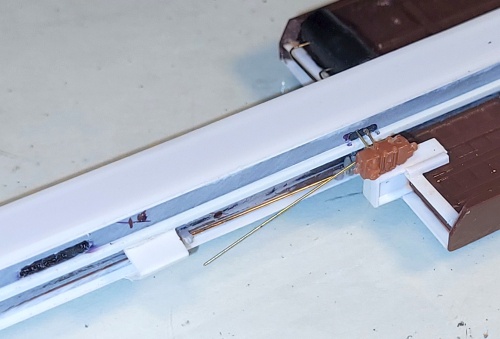
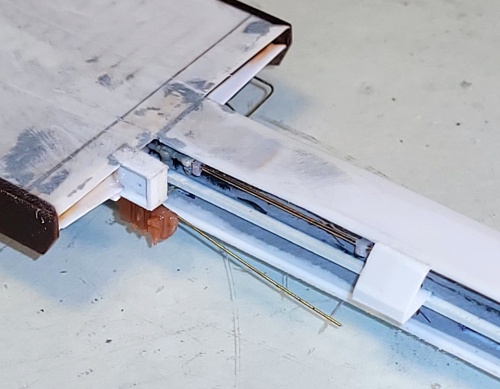
Right: I removed the underframing
in the open deck area, and cut out
a portion of the sidesills to create
the "spine car" design of the
Ft-108. I also re-profiled the
remaining sidesills to match
the Ft-108 prototype.
in the open deck area, and cut out
a portion of the sidesills to create
the "spine car" design of the
Ft-108. I also re-profiled the
remaining sidesills to match
the Ft-108 prototype.
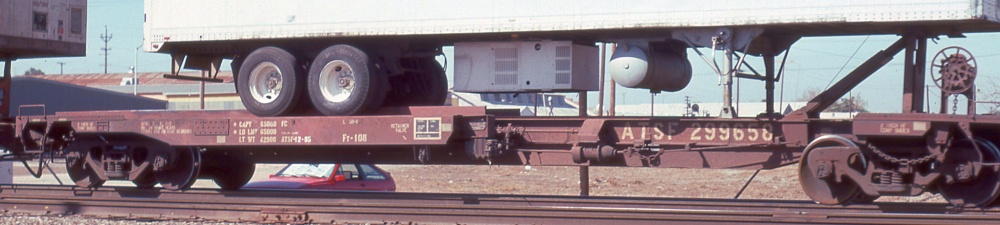
Below: This left-side view of car 299658 is lit better for examining the brake details. The triple valve is
mounted to a structural bit just outside the trailer platform. The brake cylinder is mounted to a bracket
hanging from the centersill. Note the riveted plate on the sidesill next to the dimensional data.
mounted to a structural bit just outside the trailer platform. The brake cylinder is mounted to a bracket
hanging from the centersill. Note the riveted plate on the sidesill next to the dimensional data.
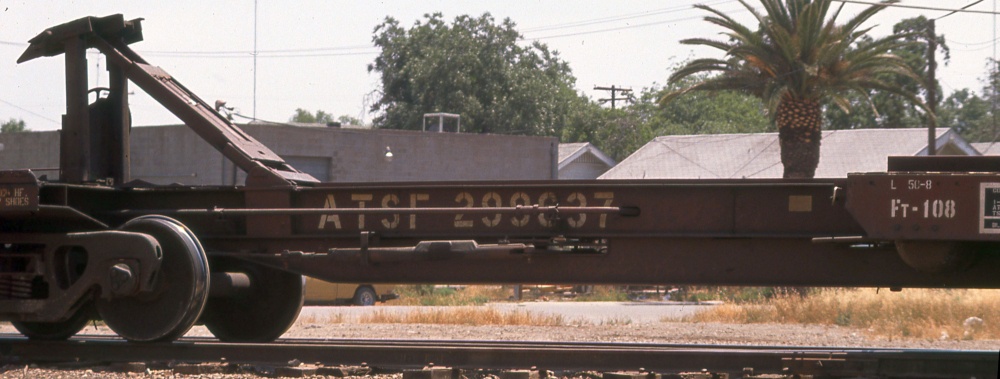
Below: Left and right views of the brake equipment in the open area between trailer platform and the small B-end deck on car 299637.
There are slots cut through the centersill for brake piping and mechanical levers to pass through. The brake wheel is chain-connected
to the brake cylinder through a complex sequence of guides and pulleys. The slack adjuster connects from a lever to the truck area.
There are slots cut through the centersill for brake piping and mechanical levers to pass through. The brake wheel is chain-connected
to the brake cylinder through a complex sequence of guides and pulleys. The slack adjuster connects from a lever to the truck area.
Below: I've tried to replicate the weathering seen on prototype car 299658 (above). But even after two rounds of PanPastels 780.5 Raw Umber
powder and dull coting, the road dust is barely visible. On the wheel platforms, I used black weathering powder to simulate wheel rub marks.
powder and dull coting, the road dust is barely visible. On the wheel platforms, I used black weathering powder to simulate wheel rub marks.
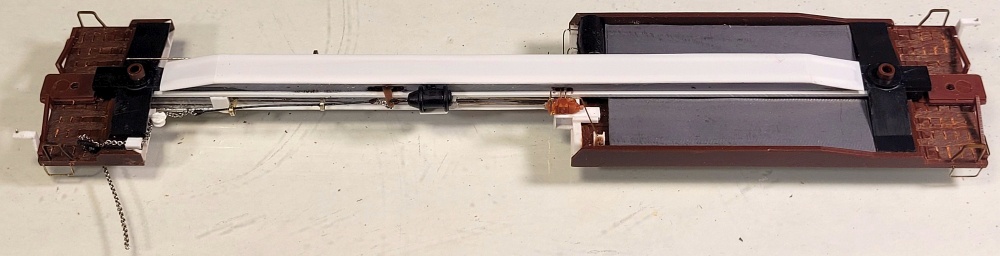
Below: I used 0.030" styrene to make new centersill sides with a deeper "fishbelly" profile. To solve a
slight warp issue with the Front Range frame (black), I installed stiff copper tube inside the centersill.
slight warp issue with the Front Range frame (black), I installed stiff copper tube inside the centersill.
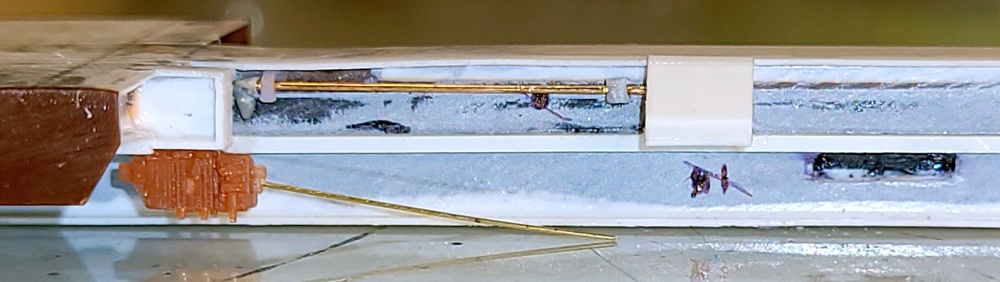
Below: The triple valve is mounted to an I-beam-like structure extending out of the left wheel platform, made from styrene I-beam with an end cap
of 0.010" styrene. Here you can see more detail of the sloped platform end supports. Brake parts are from various sets from Tichy, Cal-Scale,
and Grandt Line (now San Juan Car). I cut "false slots" into the centersill where brake piping (brass wire) passes through. I made a support for
the brake cylinder from styrene sheet. The gray pipe support brackets and junctions are custom 3D printed parts.
of 0.010" styrene. Here you can see more detail of the sloped platform end supports. Brake parts are from various sets from Tichy, Cal-Scale,
and Grandt Line (now San Juan Car). I cut "false slots" into the centersill where brake piping (brass wire) passes through. I made a support for
the brake cylinder from styrene sheet. The gray pipe support brackets and junctions are custom 3D printed parts.
Below: After filling the remaining space inside the centersill with sheet lead for added weight, I used 0.010"
sheet styrene to create the bottom flange, and square styrene strip for the centersill stiffeners. I used
styrene angle to fabricate sloped frame supports with bottom flanges at either end of the open areas.
sheet styrene to create the bottom flange, and square styrene strip for the centersill stiffeners. I used
styrene angle to fabricate sloped frame supports with bottom flanges at either end of the open areas.
Below: I used 0.010" sheet styrene to cover the Front Range deck, including a top flange for the centersill, simulating welded steel. This also
forms the top flange of the sloped platform supports. The Details West trailer hitch base was installed here to fit with the styrene decking.
forms the top flange of the sloped platform supports. The Details West trailer hitch base was installed here to fit with the styrene decking.
Below: Next I installed the remainder of the brake rigging, the wire corner grabs, and the A-Line stirrup steps.
The brake rod supports are flat brass strips bent into loops and inserted into holes drilled into the centersill for strength.
The brake rod supports are flat brass strips bent into loops and inserted into holes drilled into the centersill for strength.
Below: On the right side is the slack adjuster, built up from various bits of styrene and parts from the scrapbox.
Below: This bottom view reveals more detail of the right side rigging. I cut a brake lever in half and mounted it into the "false slot" in
the centersill, and attached the slack adjuster to it. I added sheet lead under the wheel platforms for more weight.
the centersill, and attached the slack adjuster to it. I added sheet lead under the wheel platforms for more weight.
Below: This bottom view reveals more detail of the left side rigging. The brake cylinder is the stock Front Range part. Another half-lever is
mounted into the "false slot" on this side, attached to the brake cylinder piston and a short length of fine chain, which in turn is attached to a
plastic brake rod with clevis. The other end of the rod is attached to a long length of chain, which passes around a scratch-built styrene
"pulley", through a styrene channel "guide", over a plastic "fulcrum", and then through a hole in the deck where it will attach to the brake stand.
I also mounted a Precision Scale retainer valve to a styrene H-beam mounted to the inside of the side sill, with a
wire conduit running over to the triple valve. I added two fine wire retainer handles, one on each side of the car.
mounted into the "false slot" on this side, attached to the brake cylinder piston and a short length of fine chain, which in turn is attached to a
plastic brake rod with clevis. The other end of the rod is attached to a long length of chain, which passes around a scratch-built styrene
"pulley", through a styrene channel "guide", over a plastic "fulcrum", and then through a hole in the deck where it will attach to the brake stand.
I also mounted a Precision Scale retainer valve to a styrene H-beam mounted to the inside of the side sill, with a
wire conduit running over to the triple valve. I added two fine wire retainer handles, one on each side of the car.
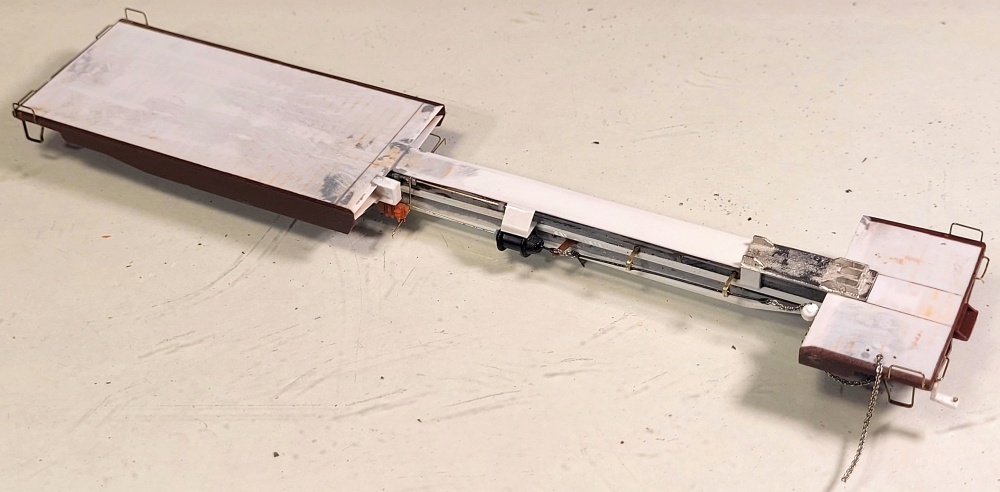
Below: The completed left side, ready for primer. The brake stand/wheel is mounted on styrene angle
verticals, with wire supports mounted into the deck. The Details West hitch has been added to its base.
verticals, with wire supports mounted into the deck. The Details West hitch has been added to its base.
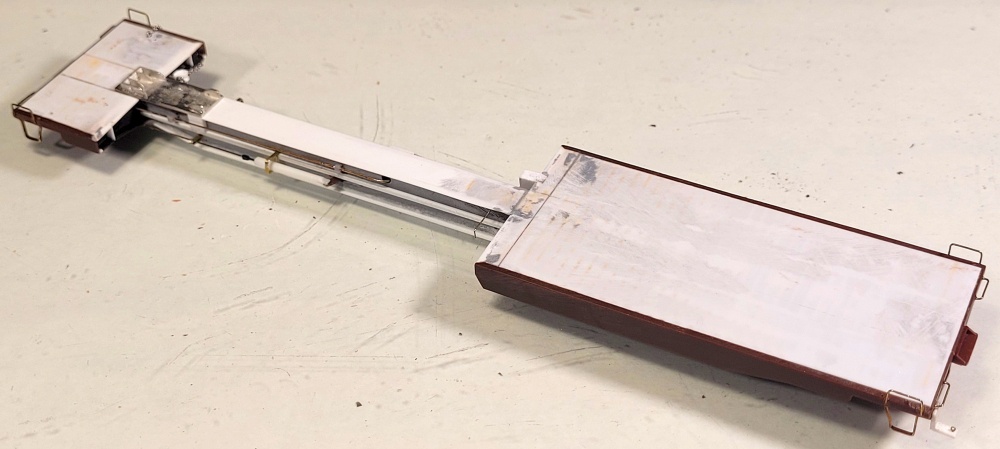
Below: The completed right side, ready for primer. The "back side" of the brake stand/wheel styrene angle uprights is visible.
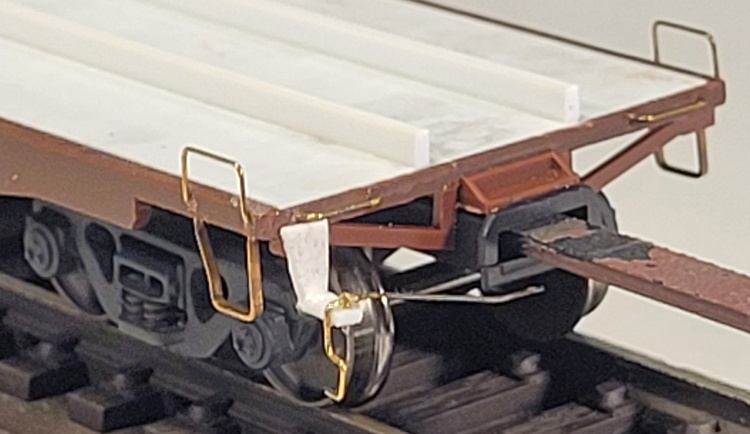
Right: On both ends, I made cut
lever brackets from large styrene
angle. I made cut levers from
brass wire, passed them through
wire eyebolts mounted to the
brackets, and ACC glued in place.
After painting, I added train line
air hoses (Hi Tech Details).
During painting, decaling, and
weathering, I use 3D-printed
"drawbars" in the coupler pockets
as handles so I can move the car
around without touching it.
lever brackets from large styrene
angle. I made cut levers from
brass wire, passed them through
wire eyebolts mounted to the
brackets, and ACC glued in place.
After painting, I added train line
air hoses (Hi Tech Details).
During painting, decaling, and
weathering, I use 3D-printed
"drawbars" in the coupler pockets
as handles so I can move the car
around without touching it.
To finish the car, I painted it ATSF Mineral Brown, including the trucks and trailer hitch per
the prototype photos. The decals were pieced together from various Microscale sets.
the prototype photos. The decals were pieced together from various Microscale sets.