|
|


















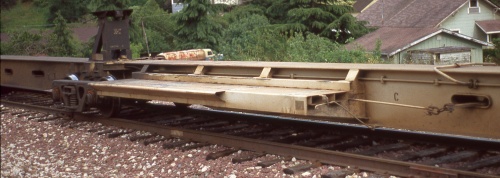

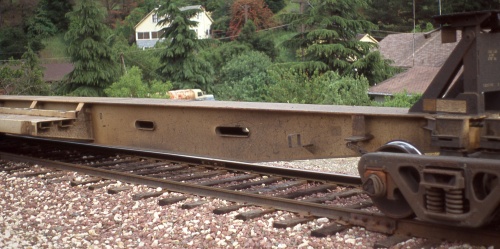
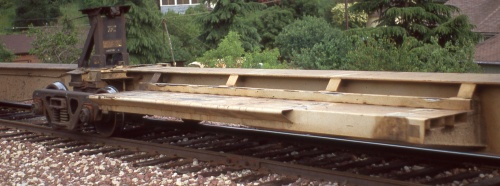

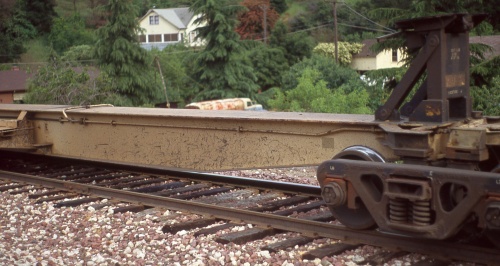


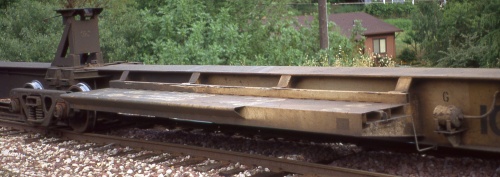

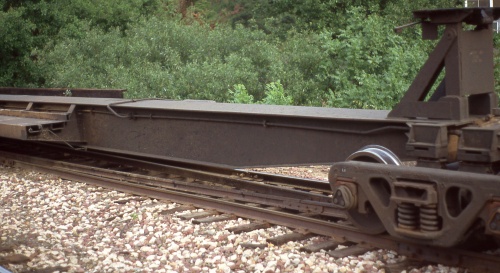
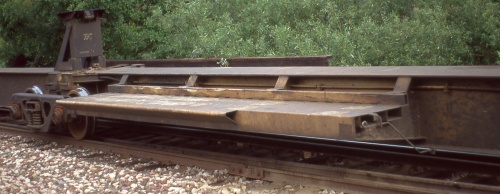


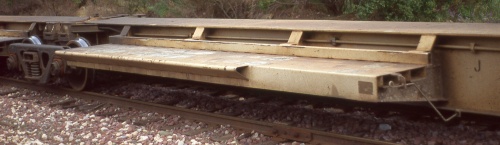
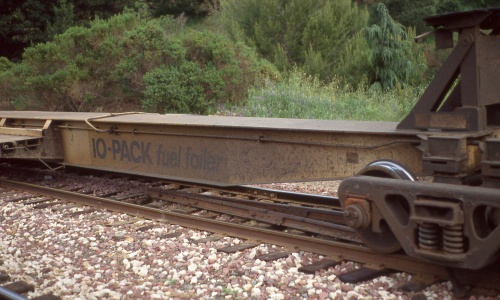

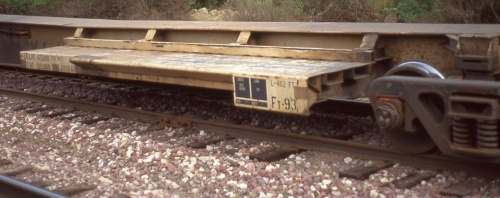
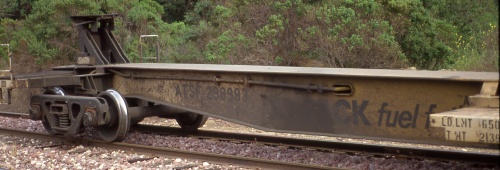
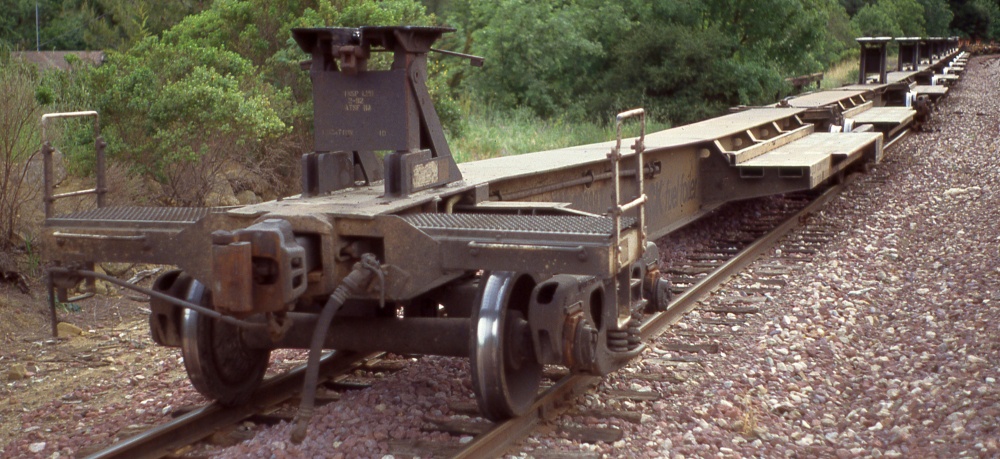















ATSF 298993 Ft-93 10-pack Fuel Foiler Spine Car
PROTOTYPE
Santa Fe invented the "spine car" in 1977 with a single 6-unit Ft-92 test car, the predecessor of the
production Ft-93 10-unit cars built in 1978. The very similar Ft-101 10-packs were built in 1980.
The original brake rigging was rather complex, and Santa Fe later simplified
the brake system, as shown in these prototype photos I've collected.
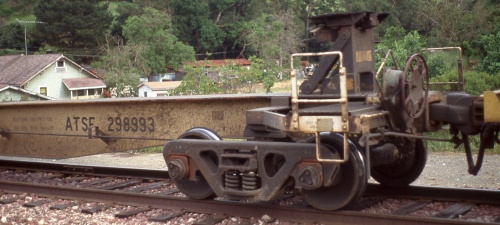
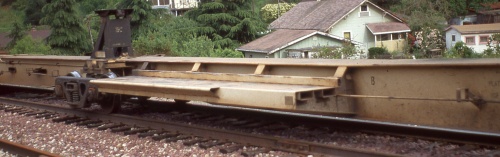
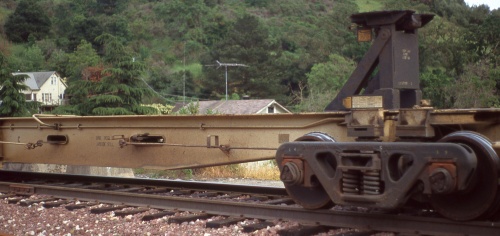
Most 10-packs lasted into the mid-1990's, and I took a series of photos of Ft-93 car 298993 at
Glen Frazer siding in May 1993, which became the prototype for my model. Other images are from the
Dec 1997 Model Railroading magazine article (Doug Geiger Ft-101 photos), and a few from the internet.
For clarity, the order of units is, from the brake end:
B-C-D-E-F-G-H-I-J-A
As with all freight cars, when facing the brake end with the brake wheel,
the car's "left side" is on your left and its "right side" is on your right.
PROTOTYPE
Santa Fe invented the "spine car" in 1977 with a single 6-unit Ft-92 test car, the predecessor of the
production Ft-93 10-unit cars built in 1978. The very similar Ft-101 10-packs were built in 1980.
The original brake rigging was rather complex, and Santa Fe later simplified
the brake system, as shown in these prototype photos I've collected.
Most 10-packs lasted into the mid-1990's, and I took a series of photos of Ft-93 car 298993 at
Glen Frazer siding in May 1993, which became the prototype for my model. Other images are from the
Dec 1997 Model Railroading magazine article (Doug Geiger Ft-101 photos), and a few from the internet.
For clarity, the order of units is, from the brake end:
B-C-D-E-F-G-H-I-J-A
As with all freight cars, when facing the brake end with the brake wheel,
the car's "left side" is on your left and its "right side" is on your right.
-- About
-- Contact
-- Diesels
-- Links
-- Layouts
-- Modules
-- Signalling
Above and Right: the left side brake end with the angled brake wheel
painted red. Note the structural elements visible at the end of the wheel
platform, and the triangular-cross-section platform extension for 102"
wide trailers - both primary inspirations for my custom trailer platforms.
painted red. Note the structural elements visible at the end of the wheel
platform, and the triangular-cross-section platform extension for 102"
wide trailers - both primary inspirations for my custom trailer platforms.
entire website copyright Gregg Fuhriman
created with CoffeeCup Visual Site Designer
created with CoffeeCup Visual Site Designer
Below: the right side has a reduction valve mounted on the centersill and tied into the train-line pipe. Units F and A also
have reduction valves. These images also show how the tops of the end unit centersills (B and A units) slope up toward
the car ends. To compensate for this, the trailer hitches on the B and A units are slightly shorter than on the mid units.
have reduction valves. These images also show how the tops of the end unit centersills (B and A units) slope up toward
the car ends. To compensate for this, the trailer hitches on the B and A units are slightly shorter than on the mid units.
Above and Right: the left side has mechanical brake linkages
supported by a square loop, with levers passing through slots in
the centersill. Note the air pipe junction with a pipe passing over
the centersill top - this connects to a triple valve on the opposite
side. Also note the retainer handle attached to the platform end
and passing beneath the centersill to the triple valve.
"BRK. REGL. INSIDE SILL" is marked between the two slots.
supported by a square loop, with levers passing through slots in
the centersill. Note the air pipe junction with a pipe passing over
the centersill top - this connects to a triple valve on the opposite
side. Also note the retainer handle attached to the platform end
and passing beneath the centersill to the triple valve.
"BRK. REGL. INSIDE SILL" is marked between the two slots.
Below: the right side has a triple valve and reservoir tank, mounted to the centersill on brackets. Units E, G, H, and J
also have combo triple valve/reservoirs. Note the retainer valve and conduit tucked under the platform end. Also a
mechanical linkage supported by another square loop, and its lever passing through a centersill slot.
All of the air reservoirs are marked with a white-on-black data patch. All hitches have two yellow safety labels on both sides.
also have combo triple valve/reservoirs. Note the retainer valve and conduit tucked under the platform end. Also a
mechanical linkage supported by another square loop, and its lever passing through a centersill slot.
All of the air reservoirs are marked with a white-on-black data patch. All hitches have two yellow safety labels on both sides.
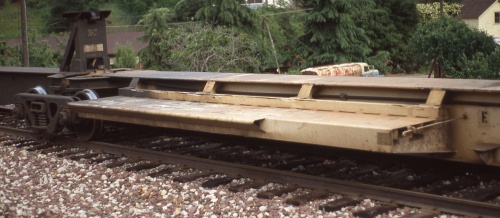
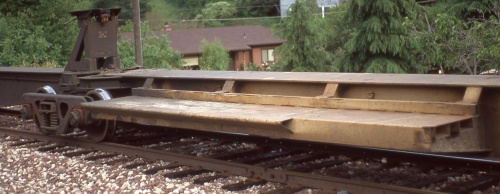
Above and Right: the left side has two empty centersill slots, where the
original brake rigging was removed during modification. Note also
the derelict square support loop and a bracket near the trailer hitch.
original brake rigging was removed during modification. Note also
the derelict square support loop and a bracket near the trailer hitch.
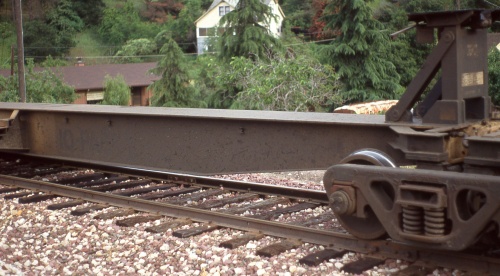
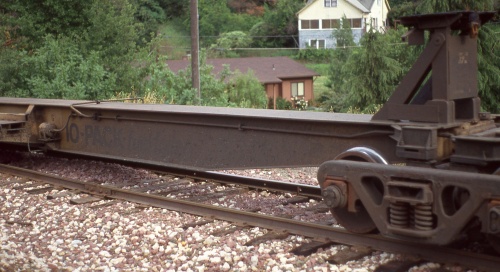
Below: the two empty centersill slots are quite obvious, plus another derelict support bracket under the right-most slot.
The main train-line pipe runs the length of the right side, connected between units by flexible hoses at the articulated joints.
The main train-line pipe runs the length of the right side, connected between units by flexible hoses at the articulated joints.
Above and Right: the left side has piping with a junction connecting
over the centersill to the triple valve. Note the derelict support bracket
near the platform end, and the retainer handle passing through the
centersill. Compare this to unit C, above.
over the centersill to the triple valve. Note the derelict support bracket
near the platform end, and the retainer handle passing through the
centersill. Compare this to unit C, above.
Below: The right side has another triple valve/reservoir combo similar to unit C. But this unit also has a flexible joint
in the train-line piping. Note the small pipe fittings all along the piping - I replicated these with custom 3D printed parts.
in the train-line piping. Note the small pipe fittings all along the piping - I replicated these with custom 3D printed parts.
Above and Right: the left side is very plain, with just a few derelict
pipe fittings remaining from the brake modification process. There
is a yellow 10-PACK logo under all that road grime.
pipe fittings remaining from the brake modification process. There
is a yellow 10-PACK logo under all that road grime.
Below: The right side has another reduction valve - compare to the B unit, above.
There is also another flexible joint in the train line - Santa Fe added these with the brake modifications.
There is also another flexible joint in the train line - Santa Fe added these with the brake modifications.
All:
Only the two end units A and B have the car reporting mark (e.g. "ATSF 298993") on both sides.
The B unit left side is marked with "Platforms Equipped For 102 Inch Wide Trailers", referring to the platform extensions.
The B unit right side has the dimensional data on the platform edge, and a plate with the lube information and car class (e.g. "Ft-93").
All units are marked with a small capital letter designating which unit it is (e.g. the small "B" on the centersill near the platform).
All units have a few reflective rectangles distributed along each side.
Santa Fe's later Helvetica font is used throughout for lettering.
Only the two end units A and B have the car reporting mark (e.g. "ATSF 298993") on both sides.
The B unit left side is marked with "Platforms Equipped For 102 Inch Wide Trailers", referring to the platform extensions.
The B unit right side has the dimensional data on the platform edge, and a plate with the lube information and car class (e.g. "Ft-93").
All units are marked with a small capital letter designating which unit it is (e.g. the small "B" on the centersill near the platform).
All units have a few reflective rectangles distributed along each side.
Santa Fe's later Helvetica font is used throughout for lettering.
Above and Right: the left side features a unique small reservoir
mounted on a bracket and fitted with curved piping. There is a pipe
junction branching over the centersill to a triple valve on the opposite
side. A retainer handle passes beneath the centersill to the triple
valve. There's another yellow 10-PACK logo under all that road grime.
mounted on a bracket and fitted with curved piping. There is a pipe
junction branching over the centersill to a triple valve on the opposite
side. A retainer handle passes beneath the centersill to the triple
valve. There's another yellow 10-PACK logo under all that road grime.
Below: The right side has another triple valve/reservoir combo. Otherwise there is nothing new here.
Above and Right: the left side has a pipe junction branching over the
centersill to a triple valve on the opposite side. A retainer handle
passes beneath the centersill to the triple valve. Compare to units
C, E, and G above. I don't believe there is a yellow 10-PACK logo,
but it's hard to tell with all that road grime.
passes beneath the centersill to the triple valve. Compare to units
C, E, and G above. I don't believe there is a yellow 10-PACK logo,
but it's hard to tell with all that road grime.
Note: I could not find a right-side photo of unit H. But the over-the-centersill piping indicates it has another triple valve/reservoir combo.
Note: I could not find a left-side photo of unit I. But the lack of over-the-centersill piping indicates there is no piping or junctions.
Below: The right side has just the train-line piping, but with another flexible joint. There is a yellow 10-PACK logo.
Below: The right side has just the train-line piping, but with another flexible joint. There is a yellow 10-PACK logo.
Above and Right: the left side has a pipe junction branching over the
centersill to a triple valve on the opposite side. A retainer handle
passes beneath the centersill to the triple valve. Compare to units
C, E, G, and H above. There is a yellow 10-PACK logo.
passes beneath the centersill to the triple valve. Compare to units
C, E, G, and H above. There is a yellow 10-PACK logo.
Note: I could not find a right-side photo of unit J. But the over-the-centersill piping indicates it has another triple valve/reservoir combo.
Above and Right: the left side has the train-line pipe passing through a
small centersill slot to the opposite side (the train-line pipe continues
down the right side all the way to the B unit). There is a yellow 10-PACK
logo. There are similar markings as the B unit's right side (see above).
small centersill slot to the opposite side (the train-line pipe continues
down the right side all the way to the B unit). There is a yellow 10-PACK
logo. There are similar markings as the B unit's right side (see above).
Below: The A unit end showing the walkway and ladder structures, the uncoupling lever and coupler box, and train-line air hose.
The B unit end is similar but also has the angled brake stand and wheel (see above).
The entire car is visible in this photo. Note how the A unit arrangement is reversed from the other nine units, such that
a trailer on unit A rides back-to-back with a trailer on unit J, while trailers on units J through B ride "circus" style (front-to-back).
On the platforms, note the small D-shaped cutouts in the supports adjacent to the centersill - these
are present on all supports of all units on both sides, and allow the piping to pass through.
Details of the trailer hitch can also be seen, including small data markings.
Note the "LOCATION 10" marking, suggesting the hitches were numbered from "1" on the B unit to "10" on the A unit.
The B unit end is similar but also has the angled brake stand and wheel (see above).
The entire car is visible in this photo. Note how the A unit arrangement is reversed from the other nine units, such that
a trailer on unit A rides back-to-back with a trailer on unit J, while trailers on units J through B ride "circus" style (front-to-back).
On the platforms, note the small D-shaped cutouts in the supports adjacent to the centersill - these
are present on all supports of all units on both sides, and allow the piping to pass through.
Details of the trailer hitch can also be seen, including small data markings.
Note the "LOCATION 10" marking, suggesting the hitches were numbered from "1" on the B unit to "10" on the A unit.
Below: The right side has a reduction valve connected into the train-line pipe where it passes through a small slot in the centersill.
This photo is of a car early in its life, before the platform extensions were added.
It is very likely the marking "Platforms Equipped For 102 Inch Wide Trailers" was added at that time.
This photo is of a car early in its life, before the platform extensions were added.
It is very likely the marking "Platforms Equipped For 102 Inch Wide Trailers" was added at that time.